
- Published
- Published 24 May 2026
- Reviewed
- Reviewed 31 May 2026
- Reading time
- 20 min read
- Sources
- 11 sources
Index
- Quick Answer
- Why the 51 Shakti Peeth Lists Differ
- The Story Behind the Shakti Peeths
- Shakti Peeth, Devi, and Bhairava
- Major Shakti Peeths Most Devotees Search For
- A Practical 51 Shakti Peeth Reference List
- How to Read a Shakti Peeth List With Body Parts
- How to Plan Shakti Peeth Darshan
- Best Time to Visit Shakti Peeths
- What to Prepare for Shakti Peeth Darshan
- What to Check Before Visiting
- Why Shakti Peeth Worship Matters
- Useful Links for Devotees
- FAQ
- Are there exactly 51 Shakti Peeths?
- Why do different websites show different Shakti Peeth names?
- Which Shakti Peeth should I visit first?
- Which Shakti Peeths are best for a first family yatra?
- Is Kamakhya the most important Shakti Peeth?
- Can all 51 Shakti Peeths be visited in one yatra?
- Do I need to visit the Bhairava shrine also?
The 51 Shakti Peeths are among the most sacred Devi pilgrimage places in Sanatana Dharma. They are remembered as the seats of Adi Shakti, linked to the story of Maa Sati, Bhagavan Shiva, and the descent of the Goddess's presence across Bharata and nearby sacred regions.
If you are searching for a 51 Shakti Peeth list, a Shakti Peeth list with body parts, or the most important Devi temples in India, it helps to begin with one honest point: different traditions do not always give the same 51 names, the same body-part association, or even the same modern place identification. That does not make the tradition weak. It shows how deeply local temple memory, Puranic narration, Shakta practice, and regional pilgrimage have grown around Devi worship.
Use this guide as a practical and devotional map. For detailed darshan planning, open the individual temple records wherever PujaKit has a focused guide, then confirm timings and local rules before travel.
Quick Answer
A Shakti Peeth is a sacred seat of Devi associated with the story of Maa Sati. The most widely followed lists speak of 51 Shakti Peeths, though some traditions count 52, 64, or 108 sacred seats. Each Peeth is connected with a form of Devi, a Bhairava, and in many lists a body part or ornament of Sati.
For devotees, the point is not only historical geography. A Shakti Peeth is a living place of darshan, vrata, mantra, Navratri worship, family vows, and Devi upasana. Some Peeths are large public pilgrimage centers such as Kamakhya, Kalighat, Jwala Ji, Ambaji, Mahalakshmi Kolhapur, and Tripura Sundari. Others are smaller, regionally preserved, disputed, or difficult to access.
For a first-time reader, this is the most useful way to understand the topic:
| Question people ask | Clear answer |
|---|---|
| What is a Shakti Peeth? | A sacred Devi seat connected with Maa Sati, Adi Shakti, and a local form of the Goddess. |
| Are all 51 in India? | Many are in India, but several traditions include sites in Nepal, Bangladesh, Pakistan, Sri Lanka, or border regions. |
| Is the body-part list fixed? | No. Body-part associations vary across texts, regions, and temple traditions. |
| Which Peeths are easiest to visit? | Kamakhya, Kalighat, Jwala Ji, Chintpurni, Naina Devi, Ambaji, Vishalakshi Kashi, Mahalakshmi Kolhapur, and Tripura Sundari are common starting points. |
| When should I visit? | Navratri is powerful but crowded. Ordinary weekdays outside major melas are easier for peaceful darshan. |
Why the 51 Shakti Peeth Lists Differ
Most online lists flatten the tradition into a single table, but devotees quickly notice differences. One source may call a site Sugandha, another Sughanda. One may identify a Peeth with Bangladesh, another with Bengal. Some traditions include a famous Devi shrine as an associated Shakti place but not as a strict canonical Peeth. In a few cases, the modern location is uncertain.
This happens for several reasons:
- Shakta texts and later regional lists developed across different periods.
- Place names changed across Sanskrit, Bengali, Hindi, Tamil, Telugu, Gujarati, Marathi, Nepali, and local usage.
- Some Peeth names describe the Devi, while others describe the town, river, hill, or older region.
- A few border-region sites are difficult to verify or visit today.
- Temple traditions preserve local memory even when textual lists differ.
For PujaKit, the best long-term approach is to keep the guide transparent: mention the traditional association, mark disputed identities where needed, and connect each known site to a focused temple record instead of creating duplicate records.
This is also better for trust. A single page that pretends there is no variation may look simple, but it disappoints serious readers. A good Shakti Peeth guide should help devotees compare names, understand why lists differ, and move toward actual darshan with confidence.
The Story Behind the Shakti Peeths
The common devotional narration begins with Daksha's yajna. Maa Sati, daughter of Daksha and consort of Bhagavan Shiva, entered the sacrificial fire after Daksha insulted Shiva. Shiva, overcome with grief, carried Sati's body and wandered in cosmic sorrow. To restore balance, Bhagavan Vishnu used the Sudarshana Chakra, and the places where Sati's body parts or ornaments fell became sacred seats of Shakti.
In this story, geography becomes theology. The body of Devi is not remembered as loss alone; it becomes presence. Rivers, hills, caves, forests, coastal shrines, city temples, and village sanctums become living reminders that Shakti pervades the land.
That is why Shakti Peeth pilgrimage is not a checklist tour. It is a form of Devi darshan spread across regions, languages, food traditions, ritual styles, and temple customs.
Shakti Peeth, Devi, and Bhairava
Most Shakti Peeth traditions remember three connected elements:
- The Peeth: the sacred seat or place where Devi is worshipped.
- The Devi form: the local name or manifestation of the Goddess.
- The Bhairava: the Shiva form associated with that Peeth.
This pairing matters. Shakti Peeth worship is not only about visiting a famous temple; it is about honoring Devi and Shiva together. At many Peeths, devotees first take darshan of the Goddess and then visit the associated Bhairava shrine, or at least remember Bhairava in prayer.
The body-part association is meaningful, but it should not be treated like a mechanical fact sheet. In practice, the living temple tradition, mantra, local deity name, Navratri worship, and darshan rules are just as important.
Major Shakti Peeths Most Devotees Search For
These are among the best-known Shakti Peeths and Devi centers in the PujaKit temple database. They are good starting points for devotees planning an accessible Shakta pilgrimage.
| Shakti Peeth or Devi site | Location | Traditional association | Why devotees visit |
|---|---|---|---|
| Kamakhya | Guwahati, Assam | Yoni Peeth; one of the most important Shakta seats | Ambubachi Mela, Tantra tradition, no anthropomorphic idol in the sanctum. |
| Kalighat | Kolkata, West Bengal | Often linked with Sati's toes | Historic Kali temple, intense urban pilgrimage, Kali Puja, daily Devi darshan. |
| Jwala Ji | Kangra, Himachal Pradesh | Tongue of Sati in many lists | Eternal natural flames worshipped as Devi, no conventional idol. |
| Chintpurni | Una, Himachal Pradesh | Feet of Sati in local tradition | Chhinnamastika worship, Navratri crowds, accessible Himachal Shakti circuit. |
| Naina Devi | Himachal Pradesh | Eyes of Sati | Hilltop Devi darshan, ropeway access, Navratri pilgrimage. |
| Ambaji | Banaskantha, Gujarat | Heart of Sati in many traditions | Vishwa Yantra worship, Gabbar Hill, major Gujarat Shakti pilgrimage. |
| Mahalakshmi Kolhapur | Kolhapur, Maharashtra | Maha Shakti Peeth; body-part traditions vary | Ambabai darshan, Kiranotsava, major Maharashtra Devi seat. |
| Tripura Sundari | Udaipur, Tripura | Right foot in several lists | Matabari shrine, Shodashi worship, Kalyan Sagar, eastern India pilgrimage. |
| Tarapith | Birbhum, West Bengal | Tara Shakti tradition; body-part associations vary | Tara worship, Bamakhepa memory, cremation-ground Tantra tradition. |
| Kumari Kanyakumari | Kanyakumari, Tamil Nadu | Back or spine in some lists | Devi as the eternal virgin, southern ocean confluence, sunrise-sunset darshan. |
If your family is planning during Navratri, check the Daily Panchang and temple announcements before finalizing dates. Many Devi temples have special queues, extended darshan hours, kumari puja, havan, or local mela arrangements during this period.
A Practical 51 Shakti Peeth Reference List
The table below is a devotional reference, not a claim that every sampradaya, temple lineage, or regional list names the same sites in the same order. The Planning note column keeps the reader aware of a simple truth: some Peeths are widely accepted starting points, while others vary by tradition and should be confirmed locally.
Current reading note: 37 entries are commonly listed as easier starting points, 13 vary by tradition, and 1 overlaps with another Ujjain tradition. For travel, darshan, or family sankalpa planning, always confirm the local temple tradition and current access rules before relying on a body-part label or modern location claim.
Last checked: 2026-05-31. PujaKit uses the table as a careful devotional baseline, not as a final scholarly settlement. Official temple/trust/government sources are preferred for living temples; traditional lists, lineage references, and careful tradition notes are kept visible where claims vary.
| # | Peeth or common name | Present-day region | Body-part tradition | Shakti name | Bhairava name | Planning note |
|---|---|---|---|---|---|---|
| 1 | Kamakhya | Guwahati, Assam, India | Yoni / womb | Kamakhya | Umananda | Commonly listed; confirm locally |
| 2 | Kalighat | Kolkata, West Bengal, India | Right toes / right foot digits | Kalika | Nakulesh | Commonly listed; confirm locally |
| 3 | Jwala Ji | Jwalamukhi, Himachal Pradesh, India | Tongue | Siddhida / Ambika | Unmatta Bhairava | Commonly listed; confirm locally |
| 4 | Chintpurni / Chhinnmastika | Una, Himachal Pradesh, India | Feet / charan | Chhinnamastika | Rudra Mahadev | Commonly listed; confirm locally |
| 5 | Naina Devi | Bilaspur, Himachal Pradesh, India | Eyes | Naina Devi | varies by tradition | Commonly listed; confirm locally |
| 6 | Ambaji | Banaskantha, Gujarat, India | Heart | Ambaji / Amba | Batuk Bhairav | Commonly listed; confirm locally |
| 7 | Tripura Sundari | Udaipur, Tripura, India | Right foot | Tripura Sundari | Tripuresh | Commonly listed; confirm locally |
| 8 | Hinglaj | Balochistan, Pakistan | Head / brahmarandhra | Kottari / Hinglaj Mata | Bhimlochan | Commonly listed; confirm locally |
| 9 | Vishalakshi Kashi | Varanasi, Uttar Pradesh, India | Earrings / face-related ornament | Vishalakshi | Kala Bhairava | Commonly listed; confirm locally |
| 10 | Kanyakumari | Kanyakumari, Tamil Nadu, India | Back / spine | Kumari / Sarvani | Nimisha | Commonly listed; confirm locally |
| 11 | Tarapith | Birbhum, West Bengal, India | Eyes in some lists | Tara | Akshobhya / varies by tradition | Tradition varies; confirm locally |
| 12 | Bahula | Ketugram, West Bengal, India | Left arm | Bahula | Bhiruk | Commonly listed; confirm locally |
| 13 | Attahas / Fullara | Labpur, West Bengal, India | Lower lip | Phullara | Vishvesh | Commonly listed; confirm locally |
| 14 | Kiriteswari | Murshidabad, West Bengal, India | Crown / kirit | Vimala / Kiriteswari | Samvart | Commonly listed; confirm locally |
| 15 | Nalhati | Nalhati, West Bengal, India | Windpipe / throat passage | Kalika / Jugaadya | Yogesh | Commonly listed; confirm locally |
| 16 | Kankalitala | Bolpur, West Bengal, India | Kankal / hip bone / skeleton | Devgarbha | Ruru | Commonly listed; confirm locally |
| 17 | Yogadya | Kshirgram, West Bengal, India | Right big toe / right toes | Yogadya / Jugaadya | Ksheer Khandak | Commonly listed; confirm locally |
| 18 | Vibhasha | Tamluk, West Bengal, India | Left ankle | Kapalini | Sarvanand | Commonly listed; confirm locally |
| 19 | Mangal Chandika | Ujani, West Bengal, India | Right wrist / right hand | Mangal Chandika | Kapilambar | Commonly listed; confirm locally |
| 20 | Jalpeshwari / Trisrota | Jalpaiguri, West Bengal, India | Left foot / ankle | Bhramari | Ambar | Commonly listed; confirm locally |
| 21 | Sugandha | Shikarpur / Barisal tradition, Bangladesh or Bengal variant | Nose | Sunanda / Sugandha | Tryambak | Commonly listed; confirm locally |
| 22 | Tripurmalini Jalandhar | Jalandhar, Punjab, India | Left breast | Tripurmalini | Bhishan | Commonly listed; confirm locally |
| 23 | Girija / Harasiddhi Ujjain | Ujjain, Madhya Pradesh, India | Elbow / upper arm | Avanti / Harasiddhi / Girija | Lambakarna / Kapilambar | Commonly listed; confirm locally |
| 24 | Kalmadhava | Amarkantak, Madhya Pradesh, India | Upper lip | Kali | Asitang | Commonly listed; confirm locally |
| 25 | Manas / Manasa Devi | Haridwar or Kailash/Manasarovar traditions | Mind / manas | Dakshayani / Manasa | Amar | Commonly listed; confirm locally |
| 26 | Guhyeshwari / Lalitambika | Kathmandu, Nepal | Knees | Mahamaya / Guhyeshwari | Kapali | Commonly listed; confirm locally |
| 27 | Ekavirasini Mahur | Mahur, Maharashtra, India | Upper teeth | Ekavira / Renuka | Chamara / varies by tradition | Commonly listed; confirm locally |
| 28 | Mahalakshmi Kolhapur | Kolhapur, Maharashtra, India | Eyes in some traditions | Mahalakshmi / Ambabai | Kapila / varies by tradition | Tradition varies; confirm locally |
| 29 | Godavari Teer / Draksharama | Draksharama, Andhra Pradesh, India | Left cheek / cheeks | Vishweshwari / Rakini | Dandapani / Vatsanabha | Commonly listed; confirm locally |
| 30 | Sarvashaila | Andhra Pradesh tradition | Cheeks | Rakini / Vishweshwari | Vatsanabha | Commonly listed; confirm locally |
| 31 | Ratnavali | Tamil Nadu or Bengal/eastern India in varying lists | Right shoulder | Kumari / Shiva | Kumar / varies by tradition | Commonly listed; confirm locally |
| 32 | Shivani Panchasagar | Panchasagar, Uttar Pradesh tradition | Lower teeth | Varahi / Shivani | Maharudra | Commonly listed; confirm locally |
| 33 | Shondesh / Shrihatta | Sylhet, Bangladesh tradition | Neck / left hand in variant lists | Mahalakshmi / Aparna | Sambaranand / varies by tradition | Commonly listed; confirm locally |
| 34 | Sharada Peeth | Kashmir region | Right hand in many lists | Sharada / Saraswati | varies by tradition | Commonly listed; confirm locally |
| 35 | Uma / Viraja | Jajpur, Odisha, India | Navel | Viraja / Girija / Uma | Jagannath | Commonly listed; confirm locally |
| 36 | Vimala Puri | Puri, Odisha, India | Feet / navel in variant lists | Vimala | Jagannath | Commonly listed; confirm locally |
| 37 | Mahamaya Amarnath | Kashmir, India | Throat | Mahamaya | Trisandhyeshwar | Tradition varies; confirm locally |
| 38 | Kurukshetra Savitri | Kurukshetra, Haryana, India | Ankle / heel | Savitri / Bhadrakali | Sthanu | Commonly listed; confirm locally |
| 39 | Mithila | Bihar/Nepal Mithila tradition | Shoulder | Uma / Mahadevi | Mahodara | Tradition varies; confirm locally |
| 40 | Manibandh | Pushkar / Rajasthan tradition | Wrist | Gayatri | Sarvanand | Tradition varies; confirm locally |
| 41 | Prabhas | Prabhas Patan, Gujarat, India | Stomach / abdomen | Chandrabhaga | Vakratunda | Tradition varies; confirm locally |
| 42 | Janasthana | Nashik / Maharashtra tradition | Chin | Bhramari | Vikritaksha | Tradition varies; confirm locally |
| 43 | Jayanti | Nartiang, Meghalaya, India; Bangladesh variant traditions also exist | Thigh | Jayanti / Jainteshwari | Kamadishwar / Kramadishwar | Tradition varies; confirm locally |
| 44 | Nandipur / Nandikeshwari | Sainthia, West Bengal, India | Necklace | Nandini / Nandikeshwari | Nandikeshwar | Commonly listed; confirm locally |
| 45 | Lanka Shankari | Trincomalee, Sri Lanka tradition | Anklet / groin in variant lists | Shankari / Indrakshi | Rakshaseshwar / Trikoneshwar | Tradition varies; confirm locally |
| 46 | Yamuna / Katyayani Vrindavan | Vrindavan, Uttar Pradesh, India | Hair / right arm in variant lists | Uma / Katyayani | Bhutesh | Commonly listed; confirm locally |
| 47 | Vindhyavasini | Vindhyachal, Uttar Pradesh, India | Left ankle in some lists | Vindhyavasini | Rudra / varies by tradition | Tradition varies; confirm locally |
| 48 | Sharvanand / Karachi tradition | Karachi/Sindh tradition | Right ankle | Mahishmardini | Krodhish | Tradition varies; confirm locally |
| 49 | Chattal / Chittagong | Chittagong, Bangladesh tradition | Right arm | Bhavani | Chandrasekhar | Tradition varies; confirm locally |
| 50 | Bakreshwar / Vakreshwar | Birbhum, West Bengal, India | Portion between eyebrows in some lists | Mahishmardini | Vakranath | Tradition varies; confirm locally |
| 51 | Bhairav Parvat | Ujjain / Madhya Pradesh tradition | Upper lip or elbow in variant lists | Avanti | Lambakarna | Overlap with Ujjain tradition |
Some entries are marked carefully because devotees search for them and traditional lists do not always agree. PujaKit keeps these notes cautious instead of forcing certainty: Mithila, Manibandh, Prabhas, Janasthana, Jayanti, Lanka Shankari, Sharvanand / Karachi, Chattal / Chittagong, Vindhyavasini, Bakreshwar, Mahamaya Amarnath, Mahalakshmi Kolhapur, and Tarapith should be checked with a trusted local or traditional source before treating their body part, Shakti name, Bhairava name, or modern location as settled. Bhairav Parvat is treated as an overlap with the existing Girija / Ujjain record rather than a duplicate page.
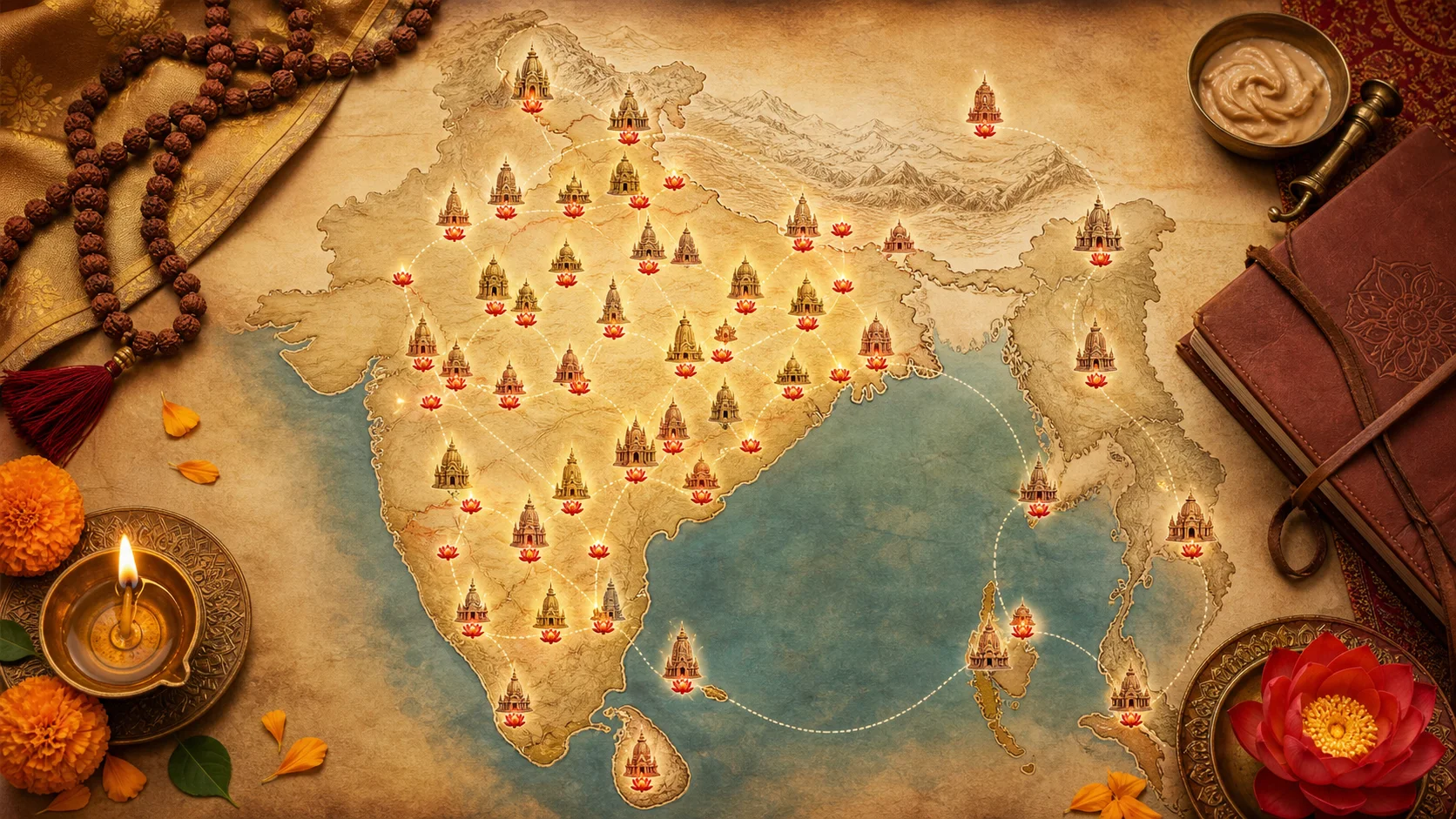
The image above is a planning visual, not a literal route map. It reflects the main idea behind Shakti Peeth yatra: the tradition is spread across many regions, so a thoughtful devotee plans by circuit rather than trying to rush every name in a single journey.
How to Read a Shakti Peeth List With Body Parts
Search results often promise a simple Shakti Peeth list with body parts, but devotees should read those tables with care. A body-part association is a devotional memory attached to the Peeth. It helps explain the sanctity of the site, but it does not always settle modern geography.
For example, one list may place a Peeth under an ancient regional name, while another uses the modern town. A Bengali list may preserve one spelling, while a Hindi or English list may use another. Some Peeths are identified by the Devi name, some by the Bhairava, and some by the local temple.
When you see a difference, ask three practical questions:
- Is the temple a living Devi shrine with local worship?
- Does the local tradition identify it as a Shakti Peeth?
- Is there enough travel information to plan darshan respectfully?
If the answer is yes, the site can still be meaningful for a devotee even when scholars or lists disagree on the exact body-part label.
How to Plan Shakti Peeth Darshan
For most families, it is better to plan Shakti Peeth darshan region by region instead of trying to cover the entire list. A well-planned regional yatra gives more time for darshan, local puja, rest, and respect for temple customs.
| Region | Good planning idea | Notes |
|---|---|---|
| West Bengal and eastern India | Kalighat, Tarapith, Kankalitala, Kiriteswari, Bahula, Nalhati, Attahas, Nandikeshwari | This region has many Shakti Peeth memories close enough for circuit planning, but local names and identifications need care. |
| Himachal Shakti circuit | Jwala Ji, Chintpurni, Naina Devi, Chamunda, Brajeshwari, Kangra-region Devi temples | Navratri brings large crowds; check road conditions and ropeway hours. |
| Gujarat and western India | Ambaji, Bahuchara Mata, Prabhas, Manibandh/Pushkar, Mahalakshmi Kolhapur if extending south-west | Good for families combining Devi darshan with longer temple travel. |
| Kashi, Braj, and north India | Vishalakshi Kashi, Katyayani Vrindavan, Manasa Devi, Kurukshetra Savitri | Useful for devotees already visiting Varanasi, Mathura-Vrindavan, Haridwar, or Haryana. |
| East and north-east India | Kamakhya, Tripura Sundari, Jayanti traditions, Shondesh where accessible | Check festival dates, weather, and border/access rules carefully. |
| Cross-border Peeths | Hinglaj, Guhyeshwari, Sharada, Lanka Shankari | Treat these as specialized pilgrimages; visa, route, security, and local restrictions matter. |
For a family pilgrimage, keep one primary Peeth as the spiritual center of the trip and add nearby temples only if time allows. This keeps the journey devotional instead of exhausting. For example, a Guwahati trip can center on Kamakhya; a Kolkata trip can center on Kalighat with nearby Bengal Shakti sites planned separately; a Himachal trip can be built around Jwala Ji, Chintpurni, and Naina Devi depending on road time.
Best Time to Visit Shakti Peeths
Navratri is the most powerful season for many Devi temples, especially Chaitra Navratri and Sharad Navratri. The atmosphere is deeply devotional, but crowds can be intense. If you are travelling with elders or children, plan darshan early in the morning and keep extra time for queues.
Ambubachi Mela at Kamakhya is a major Shakta observance and attracts large numbers of devotees. It is spiritually significant, but not the easiest time for a first-time family trip unless you are prepared for crowds and local arrangements.
For peaceful darshan, many devotees choose ordinary weekdays outside the biggest festival windows. A quieter day often allows more time for japa, sankalpa, pradakshina, and sitting near the temple after darshan.
Other useful windows include Fridays, Amavasya, Purnima, local Devi jayanti days, and regional mela days. These can be spiritually meaningful, but they vary by temple. Always check the temple's current notice board or official communication before booking travel.
What to Prepare for Shakti Peeth Darshan
Many devotees arrive at a Shakti Peeth with the right feeling but little preparation. A simple, clean approach is better than carrying too much.
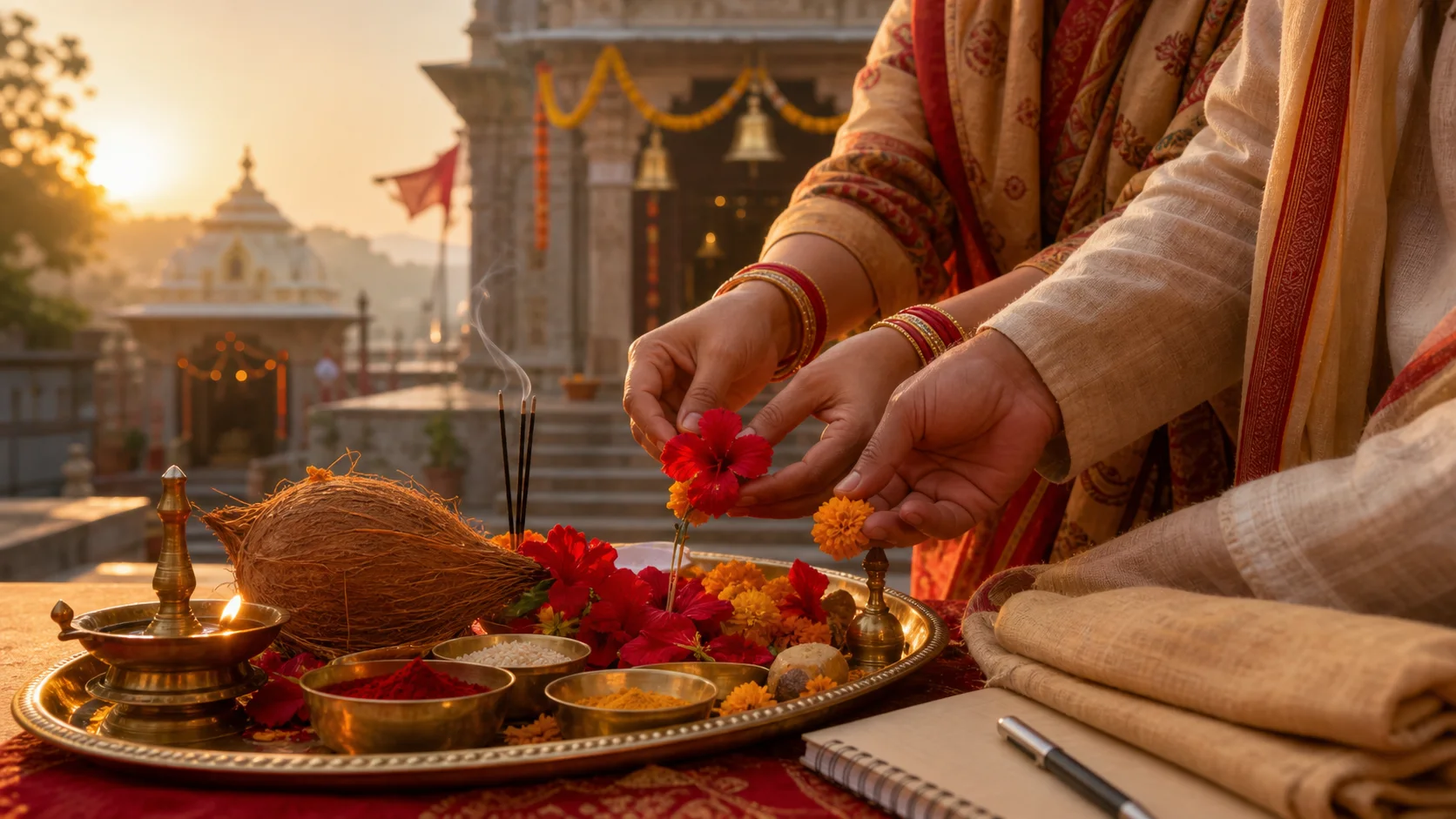
Common items for Devi darshan may include:
- Fresh flowers or a garland, especially red flowers where appropriate.
- Kumkum, haldi, akshat, coconut, and fruits.
- A clean red, yellow, or saffron cloth if the temple accepts cloth offerings.
- Sweets or local prasad, according to temple rules.
- A small notebook or phone note with your sankalpa, gotra if known, and family prayer.
- Water, light food, medicines, and comfortable footwear for long queues.
Do not assume every temple accepts every offering. Some shrines have strict rules about coconuts, cloth, photography, mobile phones, leather items, or special puja booking. The best practice is to keep offerings simple and follow the local sevaks or priests respectfully.
What to Check Before Visiting
Before visiting any Shakti Peeth, especially a smaller or disputed one, check:
- The temple's current opening hours.
- Whether online registration or special darshan tickets are required.
- Local Navratri, Amavasya, Purnima, or mela crowd patterns.
- Dress code, photography rules, and mobile restrictions.
- Whether animal sacrifice, bali, or specific local customs are part of the temple tradition, so your family can prepare respectfully.
- Nearest railway station, airport, hill-road condition, and night travel safety.
- Whether the Peeth has multiple claimed locations.
This last point matters. If a Peeth name is disputed, your goal should be devotional clarity, not argument. Follow your family tradition, local pandit guidance, or the temple lineage you trust.
Why Shakti Peeth Worship Matters
Shakti Peeths are not only old temples. They carry a powerful idea: the Divine Mother is not distant from the world. She is present in land, body, sound, flame, river, yantra, hill, village, city, and household devotion.
For some devotees, Shakti worship brings courage. For others, it brings protection, fertility, healing, discipline, prosperity, or a renewed connection with family deities. At temples such as Kamakhya, Jwala Ji, Kalighat, and Ambaji, the form of Devi may be unusual compared with a standard idol, but that is exactly the point. Shakti is not limited to one image.
When visiting a Shakti Peeth, go with humility. Learn the local name of the Goddess. Notice the Bhairava connected with the shrine. Offer what is appropriate, avoid rushing the sanctum, and leave room for silence after darshan.
Useful Links for Devotees
Use these PujaKit pages to move from reading to planning:
| Need | Helpful page |
|---|---|
| Find individual temple records | All temple guides |
| Check major Devi festival timing | Navratri guide |
| Confirm tithi, weekday, sunrise, and local Panchang | Daily Panchang |
| Browse year-round festival dates | Hindu festival calendar |
| Read major Shakti Peeth details | Kamakhya, Kalighat, Jwala Ji, Ambaji, Tripura Sundari |
FAQ
Are there exactly 51 Shakti Peeths?
The 51-list is the most searched and commonly circulated format, but some traditions count 52, 64, or 108 sacred seats of Devi. PujaKit treats 51 as a major devotional list while noting regional variations.
Why do different websites show different Shakti Peeth names?
Names differ because Shakta texts, local temple traditions, translations, and modern place identifications differ. Some entries are ancient regional names, while others are the current temple or town name.
Which Shakti Peeth should I visit first?
Start with the Peeth closest to your family tradition or travel route. For many devotees, Kamakhya, Kalighat, Jwala Ji, Chintpurni, Naina Devi, Ambaji, Tripura Sundari, Mahalakshmi Kolhapur, and Vishalakshi Kashi are practical starting points.
Which Shakti Peeths are best for a first family yatra?
For a first family yatra, choose accessible and well-managed temples such as Kamakhya, Kalighat, Jwala Ji, Chintpurni, Naina Devi, Ambaji, Tripura Sundari, Vishalakshi Kashi, or Mahalakshmi Kolhapur. These have stronger travel infrastructure than many lesser-known or disputed Peeths.
Is Kamakhya the most important Shakti Peeth?
Kamakhya is one of the most important Shakta seats and is often treated with exceptional reverence because of its Yoni Peeth tradition and Ambubachi observance. Other traditions may give special importance to their own regional Devi seat.
Can all 51 Shakti Peeths be visited in one yatra?
Practically, no for most devotees. The list spans India and nearby regions, including places with difficult access or border restrictions. A regional yatra is usually more meaningful and manageable.
Do I need to visit the Bhairava shrine also?
Where the Bhairava shrine is part of the temple circuit and accessible, many devotees include it because Shakti Peeth worship traditionally remembers Devi and Bhairava together. If time, health, or local access does not allow it, remember Bhairava in prayer and follow local guidance.