
Composing…
Jyotirlinga
Shri Grishneshwar Jyotirlinga Temple
श्री घृष्णेश्वर ज्योतिर्लिंग मंदिर
Verul (Ellora), Maharashtra
LocationMaharashtra
ॐ
DeityLord Shiva (Grishneshwar / Ghrishneshwar)
Darshan Timings05:30 – 21:30
EntryFree entry
Before You Go
Practical temple planning
Plan darshan, source checks, and puja help without assuming unofficial bookings or guaranteed access.
Darshan planning
Timing notes available
Regular hours: 05:30–21:30 daily. Temple opens for Mangal Aarti at 04:00. Darshan sessions: 06:30–12:00, 13:00–20:00, 21:00–21:30. During Shravan month (July–August): extended hours 03:00–23:00. All Mondays during Shravan: open from midnight Sunday through to midnight Monday (25+ hours). Vaikunth Chaturdashi: 05:00 to 03:00 next day. Maha Shivaratri: 00:00 (previous night) through all day. Puja timings: 06:00–11:30 (morning) and 14:00–19:00 (afternoon). Abhishek timings: 06:00–11:00 (morning) and 13:00–19:00 (afternoon).
Check sourceOfficial source
Source review needed
This profile uses available directory data; confirm booking and seva details locally before travel.
Temple contact
Contact listed
Listed contact: +91-9422714345. Use it for current queue, entry, and seva questions.

Significance
Grishneshwar is the 12th and final Jyotirlinga of Lord Shiva, the culminating shrine of the sacred circuit of twelve. The linga here is named Grishneshwar (or Ghushmeshwar / Ghrishneshwar) — meaning "Lord of Compassion" — after the devoted woman Ghushma (also called Kusuma) whose unwavering devotion caused Lord Shiva to manifest here permanently. The temple is a national protected monument of India, and pilgrims completing the Dwadasha Jyotirlinga yatra (circuit of 12) end their journey here.
“
नमामीशमीशान निर्वाणरूपं विभुं व्यापकं ब्रह्म वेदस्वरूपम्।
— आदि शंकराचार्य
Pilgrim Context
Shri Grishneshwar Jyotirlinga Temple is a Hindu sacred place in Verul (Ellora), Chhatrapati Sambhaji Nagar (Aurangabad), Maharashtra, connected with Lord Shiva (Grishneshwar / Ghrishneshwar). As a Jyotirlinga, the temple belongs to the pan-Indian Shaiva circuit where devotees worship Shiva as self-manifest light and plan darshan as part of a wider sacred route.
The original temple likely dates to the Rashtrakuta dynasty period (8th century CE onward). It was damaged and partially destroyed during the 13th–14th centuries under the Delhi Sultanate, and again during repeated Hindu–Muslim conflicts. Maloji Bhosale — grandfather of Chhatrapati Shivaji Maharaj and chief of Verul — undertook a significant restoration in the 16th century, reportedly using a hidden treasure he discovered at the site. The temple was again damaged during Mughal–Maratha conflicts (1680–1707 CE). The current structure was comprehensively rebuilt by Queen Ahilyabai Holkar of Indore in 1729 CE (some sources cite Gautami Bai Holkar earlier; the definitive Ahilyabai-attributed reconstruction is most widely cited). Ahilyabai Holkar rebuilt and renovated numerous temples across India including Somnath, Kashi Vishwanath, and Grishneshwar as an act of devotion. The temple sits adjacent to the Ellora Caves UNESCO World Heritage Site.
Major observances connected with this profile include Maha Shivaratri, Shravan Maas (Holy Month), Nag Panchami, Vaikunth Chaturdashi. During these periods, devotees should expect heavier crowds, longer queues, and a stronger emphasis on aarti, utsav, and local temple customs.
A useful visit plan begins with the darshan window, then works backward through route, footwear and bag rules, offering guidelines, queue options, and local transport from Verul (Ellora). For older shrines and high-crowd temples, early morning and non-festival weekdays usually give devotees more time for quiet prayer.
For devotional preparation, visitors can keep the practice simple: learn the main deity's name, carry only permitted offerings, observe modest dress, and close the visit with a short mantra, pradakshina, or dana where appropriate. This keeps temple travel connected to sadhana rather than only sightseeing.
Festival Focus
- Maha Shivaratri
- Shravan Maas (Holy Month)
- Nag Panchami
- Vaikunth Chaturdashi
Darshan Notes
- Mangal Aarti (Kakad Aarti) at 04:00
- Morning Jalhari Pooja (Abhishek) at 08:00
- Madhyana Aarti (Bhog Aarti) at 12:00
- Regular hours: 05:30–21:30 daily. Temple opens for Mangal Aarti at 04:00. Darshan sessions: 06:30–12:00, 13:00–20:00, 21:00–21:30. During Shravan month (July–August): extended hours 03:00–23:00. All Mondays during Shravan: open from midnight Sunday through to midnight Monday (25+ hours). Vaikunth Chaturdashi: 05:00 to 03:00 next day. Maha Shivaratri: 00:00 (previous night) through all day. Puja timings: 06:00–11:30 (morning) and 14:00–19:00 (afternoon). Abhishek timings: 06:00–11:00 (morning) and 13:00–19:00 (afternoon).
Source-backed guide
Need help arranging a puja?
Share your city, preferred date, and ritual need. PujaKit will confirm availability, samagri, pricing, and terms before any booking is finalized.
Visit Essentials
Best Time to VisitOctober – March
AltitudeNear Sea Level
🛕
Temple Status / SeasonOpen Year-round
Best ExperienceEvening Aarti & lighting
Architecture & Highlights
StyleHemadpanthi
MaterialRed volcanic rock (red laterite/basalt stone)
Built By / Era1729 CE (current structure; Ahilyabai Holkar reconstruction)
Highlights
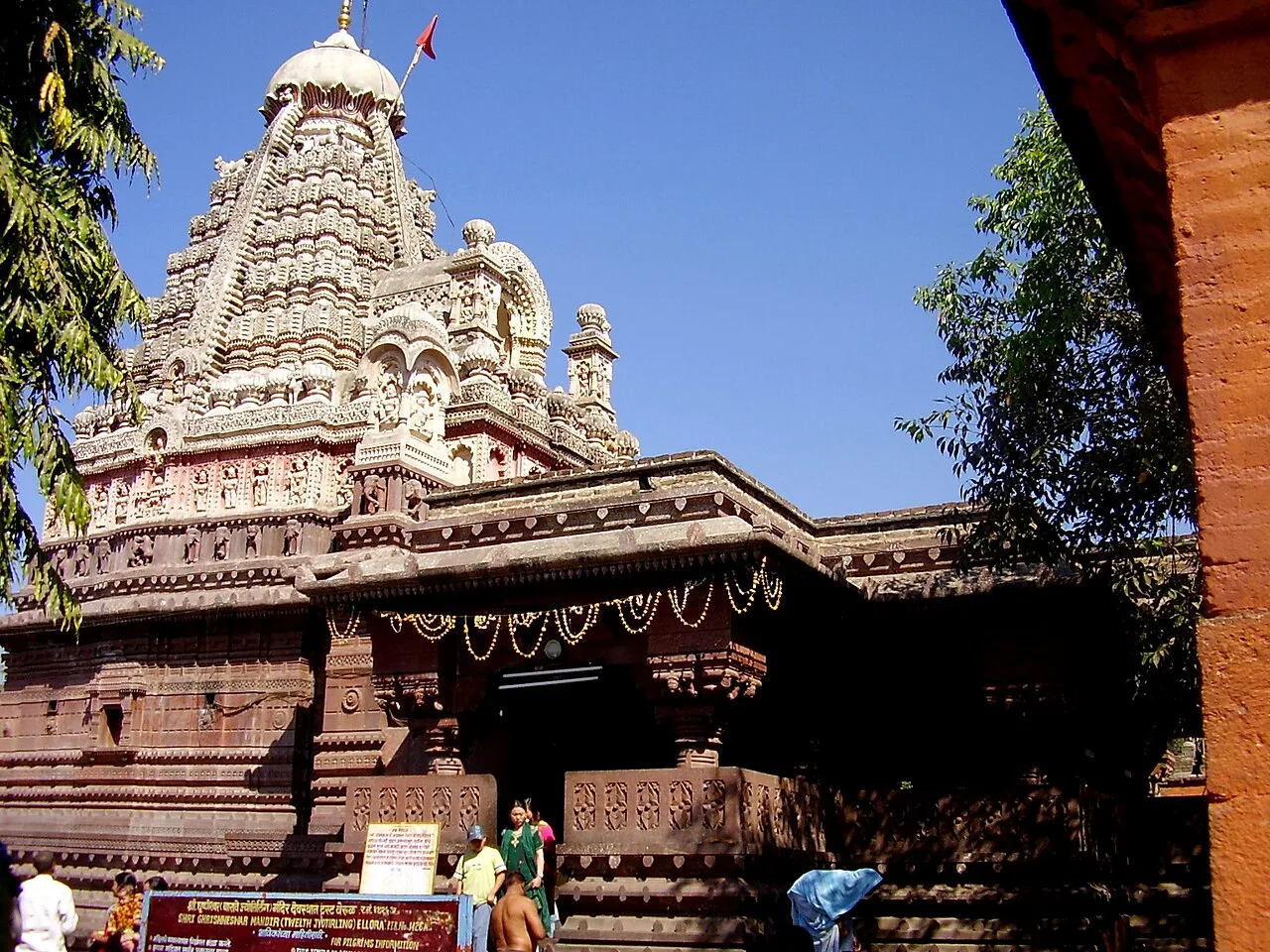
- ·Five-tiered red stone shikhara rising majestically; golden kalasha at top
- ·Intricate mythological carvings on interior and exterior walls
- ·Carvings depict Shiva legends AND Dashavatar (10 Vishnu incarnations) — rare in a Shiva temple
- ·Garbhagriha (sanctum): ~289 sq ft; Shivalinga faces east
Gallery

Grishneshwar Jyotirlinga Temple, Verul — five-tiered red stone shikhara
How to Reach
By Air35 km
Chhatrapati Sambhajinagar Airport (formerly Aurangabad Airport) (IXU)Flights from Mumbai (40 min), Hyderabad, Delhi. Taxis readily available. Renamed Chhatrapati Sambhajinagar Airport (renaming put on hold by AAI in 2025; IATA code IXU unchanged).
By Train30 km
Aurangabad Railway Station (AWB)Direct trains from Mumbai (8h), Pune (7h), Hyderabad, Nagpur, Delhi. From Aurangabad: taxis (₹800–1,200), MSRTC buses via Ellora route (every 30–60 min, ₹40–60, ~1h).
By Road~242 km
From Aurangabad city: 30 km via SH60 → NH52; ~45–60 min by taxi. MSRTC state buses run from Aurangabad Central Bus Station (CBS) to Ellora/Verul regularly (₹40–60). From Pune: 256 km, ~5h via NH52. From Nasik: 187 km, ~4h. From Shirdi: 122 km, ~2.5h. From Mumbai: ~300 km, ~6h via NH52. Note: Ellora Caves and Grishneshwar Temple are 1.5 km apart — most visitors combine both in one trip.
Tip: Best travel between October – MarchWeather can change quickly in the Himalayas. Carry proper clothing.
Location Map
Shri Grishneshwar Jyotirlinga Temple, Maharashtra
Accommodation
Stay options near Verul (Ellora)

Comfortable dharamshalas, hotel rooms, and ashram stays are available surrounding the temple zone. It is highly recommended to book stays at least 2–3 months in advance during peak season.
Nearby Places
Explore sacred places around Verul (Ellora)
🛕Local Market
1.2 km🛕Sacred Water Tank
0.5 km🛕Sunset Viewpoint
2.4 km🛕Divine Museum
3.1 km