Composing…
Major Temple
Shri Ram Janmabhoomi Temple (Ram Mandir)
श्री राम जन्मभूमि मंदिर (राम मंदिर)
Ayodhya, Uttar Pradesh
LocationUttar Pradesh
ॐ
DeityLord Ram (Shri Ram Lalla)
Darshan Timings07:00 – 23:00
EntryFree entry
Before You Go
Practical temple planning
Plan darshan, source checks, and puja help without assuming unofficial bookings or guaranteed access.
Darshan planning
Timing notes available
The temple is open from 7:00 AM to 11:00 PM (23:00) daily. Hours may be extended on festival days (especially Ram Navami, Diwali, and Vivah Panchami). Since the consecration in January 2024, authorities have progressively streamlined visitor management. Long queues are common; arrive early or in the late evening for shorter waits. No mobile phones or cameras are permitted inside the inner sanctum area; devices must be deposited at cloak rooms provided outside. Footwear must be removed before entering the complex. Security checks are in place at multiple entry gates. Devotees enter from designated gates; follow directional signage for different queue categories (general, senior citizen, differently-abled). Children under 12 and senior citizens have dedicated access lanes.
Check sourceOfficial source
Use official links first
Use the temple or trust website before paying for seva, rooms, helicopter tickets, or special darshan.
Open official siteTemple contact
Sri Ram Janmabhoomi Teerth Kshetra Trust (SRJTKT)
Listed contact: +91-5278-250100. Use it for current queue, entry, and seva questions.
Significance
The Shri Ram Janmabhoomi Temple (Ram Mandir) is arguably the most nationally significant temple consecrated in modern India. It stands at the precise location traditionally held to be the birthplace of Lord Ram — the seventh avatar of Lord Vishnu and the hero of the Valmiki Ramayana. Ram is revered across India and Southeast Asia as the ideal king (Maryada Purushottam — the supreme upholder of virtue), ideal son, ideal husband, and ideal warrior. Ayodhya itself is the Ramayana's capital city — the Ikshvaku (Solar dynasty) kingdom that Ram ruled. The site carries the cumulative spiritual and emotional weight of: — Over 500 years of Hindu aspiration to restore a temple at the birthplace — One of the longest legal battles in Indian judicial history (concluded 2019) — A landmark Supreme Court verdict — A groundbreaking ceremony presided over by the Prime Minister of India (2020) — A Pran Pratishtha (consecration) ceremony of national significance (2024) More than 8,000 saints, sages, politicians, and dignitaries attended the consecration on 22 January 2024. The day was declared a public holiday in several states; live telecasts were watched by hundreds of millions across India. Lakhs of pilgrims now visit Ayodhya monthly, making it one of India's top pilgrimage destinations virtually overnight.
“
मङ्गलम् भगवान विष्णुः मङ्गलम् गरुडध्वजः। मङ्गलम् पुण्डरीकाक्षो मङ्गलाय तनो हरिः॥
— मङ्गल मन्त्र
Pilgrim Context
Shri Ram Janmabhoomi Temple in Ayodhya is a major Rama-bhakti pilgrimage centre dedicated to Shri Ram Lalla, connected with Ayodhya’s Sapta Puri memory and the Sarayu sacred landscape.
The Ram Janmabhoomi dispute is one of the most complex and layered historical controversies in Indian history. The key timeline: **Ancient & Medieval:** - Ayodhya is mentioned as Ram's capital in the Valmiki Ramayana and is revered as one of the oldest cities in the world (referred to as "Avadh" or "Kosala"). - Temple tradition at the Janmasthan site likely dates to ancient times. - In 1528 CE, the Mughal emperor Babur's commander Mir Baqi is traditionally said to have demolished an existing Ram temple and constructed the Babri Masjid (Babur's Mosque) at the site. This claim is central to the Hindu position in the dispute; the Babri Masjid side disputed any demolition of a prior temple. - ASI excavations (2002–2003, court-ordered) found evidence of a large pre-existing structure beneath the Babri Masjid — widely interpreted by Hindus as the demolished Ram temple, though disputed by some historians. **Modern Dispute (1947–2020):** - 1949: Idols of Ram Lalla appeared inside the Babri Masjid (December); the government locked the structure; both communities filed suits. - 1984: Vishwa Hindu Parishad (VHP) launched a campaign to "liberate" the Ram Janmabhoomi; support grew through the 1980s. - 1986: A district court ordered the gates unlocked for Hindu worship; the Muslim community objected and formed the Babri Masjid Action Committee. - 6 December 1992: The Babri Masjid was demolished by a large mob of kar sevaks (Hindu religious volunteers), triggering nationwide communal riots in which over 2,000 people died. This event remains one of the most consequential in post-independence Indian history. - 2002–2003: Allahabad High Court ordered ASI excavations. - 2010: Allahabad High Court divided the 2.77-acre plot three ways between the three parties (Sunni Waqf Board, Nirmohi Akhara, and Ram Lalla Virajman). All three parties appealed to the Supreme Court. - 9 November 2019: Supreme Court of India awarded the full 2.77-acre plot to the Ram Lalla deity (managed by the newly constituted Sri Ram Janmabhoomi Teerth Kshetra Trust) and directed the government to provide 5 acres of alternative land to the Sunni Waqf Board. **Construction & Consecration:** - February 2020: Sri Ram Janmabhoomi Teerth Kshetra Trust constituted by the Central Government. - 5 August 2020: Prime Minister Narendra Modi performed the Bhumi Puja (ground- breaking ceremony) for the new temple construction, laying a 40 kg silver brick. - Construction commenced and progressed in phases through 2021–2023. - 22 January 2024: The Pran Pratishtha (consecration / installation of the life- force in the deity) was performed — the temple was officially opened. PM Modi performed the rituals alongside chief priests. The idol of Ram Lalla, created by sculptor Arun Yogiraj, was consecrated. - Phase 1 (ground floor) opened to pilgrims on 22 January 2024. The upper floors and full complex continue to be completed in subsequent phases.
Ram Navami, Diwali, Vivah Panchami, and major Ayodhya observances can create very heavy queues; plan local transport, cloakroom needs, ID, and temple-area movement conservatively.
Confirm darshan, aarti pass, bag/mobile rules, and crowd-control notices from the official trust or administration before travel, because Ayodhya visitor systems are still current-sensitive and can change quickly.
For devotional preparation, visitors can keep the practice simple: learn the main deity's name, carry only permitted offerings, observe modest dress, and close the visit with a short mantra, pradakshina, or dana where appropriate. This keeps temple travel connected to sadhana rather than only sightseeing.
Festival Focus
- Ram Navami (March–April (Chaitra Navami))
- Diwali (Deepotsav) (October–November (Kartik Amavasya))
- Vivah Panchami (November–December (Margashirsha Panchami))
- Kartik Purnima (November)
Darshan Notes
- Mangala Aarti at 07:00
- Shringar Aarti at 08:00
- Bhog Aarti (Raj Bhog) at 12:00
- The temple is open from 7:00 AM to 11:00 PM (23:00) daily. Hours may be extended on festival days (especially Ram Navami, Diwali, and Vivah Panchami). Since the consecration in January 2024, authorities have progressively streamlined visitor management. Long queues are common; arrive early or in the late evening for shorter waits. No mobile phones or cameras are permitted inside the inner sanctum area; devices must be deposited at cloak rooms provided outside. Footwear must be removed before entering the complex. Security checks are in place at multiple entry gates. Devotees enter from designated gates; follow directional signage for different queue categories (general, senior citizen, differently-abled). Children under 12 and senior citizens have dedicated access lanes.
Source-backed guide
This page uses official trust references where available and avoids unsupported claims about paid VIP access, guaranteed darshan, or third-party booking.
- The temple is dedicated to Shri Ram Lalla and is managed through the Shri Ram Janmabhoomi Teerth Kshetra trust context.
- Government tourism references identify Ayodhya Ram Mandir as a major pilgrimage destination.
- PujaKit does not publish paid VIP, guaranteed-access, or private-agent claims for this temple.
Need help arranging a puja?
Share your city, preferred date, and ritual need. PujaKit will confirm availability, samagri, pricing, and terms before any booking is finalized.
Visit Essentials
Best Time to VisitOctober – March
Altitude93 m (305 ft)
🛕
Temple Status / SeasonOpen Year-round
Best ExperienceEvening Aarti & lighting
Architecture & Highlights
StyleNagara (North Indian temple architecture); Somnath-style shikhara; specifically the 'Nagara Maru-Gurjar' variant drawing on Gujarat and Rajasthan traditions
Height49 m (161 ft)
MaterialPink sandstone from Bansi Paharpur quarries (Rajasthan); no iron or steel used in the primary structure; granite foundations
Highlights
- ·Surya Tilak Mechanism: An optical mechanism engineered by CSIR-CBRI Roorkee, IIT Roorkee, and Optica India, installed within the temple's shikhara. On Ram Navami (Ram's birthday; noon), mirrors and lenses direct a beam of natural sunlight from the shikhara top to fall precisely on the forehead of the Ram Lalla idol — a "tilak" (forehead mark) by the sun itself, referencing Ram's solar lineage (Surya Vansh / Ikshvaku dynasty). Successfully demonstrated on Ram Navami 2024 and 2025.
- ·Pink Sandstone Construction: The entire temple structure uses pink sandstone (Bansi Paharpur stone) from Rajasthan's Mirzapur district quarries — chosen for its aesthetic quality, durability, and its echo of traditional North Indian temple building. No iron or steel is used in the main structure to follow traditional Nagara construction principles; instead, copper and stone locking mechanisms hold the structure.
- ·Zero Iron Construction: Following classical Nagara temple architecture principles, no iron or steel is used in the primary temple structure. Copper clamps and traditional stone-interlocking techniques are used instead, designed for a projected lifespan of 1,000 years.
- ·Kuber Tila: An ancient Shiva temple (Kuber Tila / Kuberpur) within the complex has been retained and beautifully integrated into the compound. Kuber is the god of wealth; the site has pre-existing religious significance independent of the Ram Janmabhoomi dispute.
Gallery

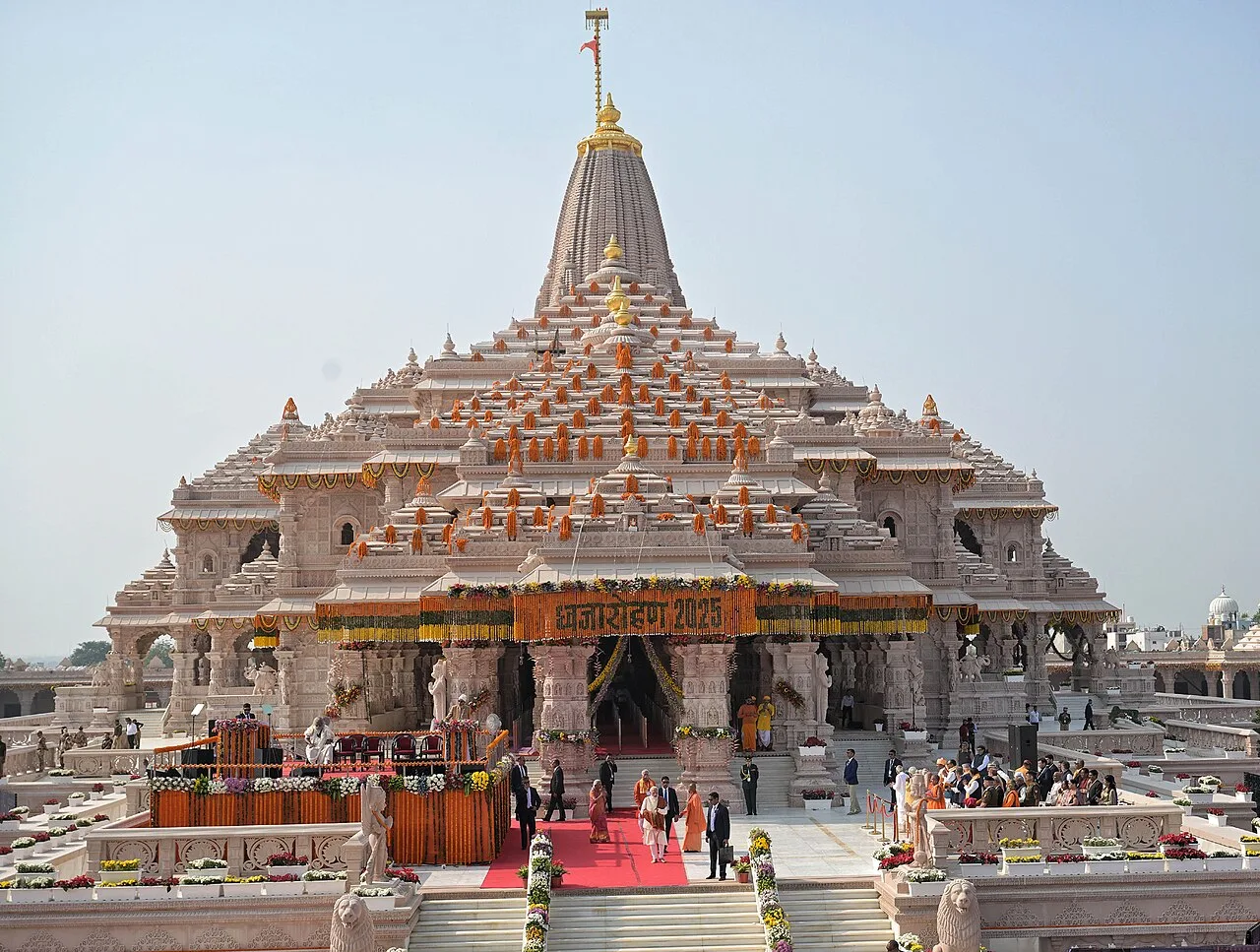
Ram Mandir (Shri Ram Janmabhoomi Temple), Ayodhya — exterior view (2024)
How to Reach
By Air km
()
By Train2 km
Ayodhya Dham Junction (formerly Faizabad Junction)Ayodhya Dham Junction (also called Ayodhya Cantt / Ayodhya Junction) was expanded and renamed in 2024 as part of the city's infrastructure upgrades for the temple consecration. The station is approximately 2 km from the Ram Mandir. Several new trains were added post-2024 connecting Ayodhya to Delhi, Mumbai, Chennai, Bengaluru, and other major cities. 'Amrit Bharat Express' and special pilgrimage trains connect major cities to Ayodhya. Auto-rickshaws and e-rickshaws connect the station to the mandir.
Tip: Best travel between October – MarchWeather can change quickly in the Himalayas. Carry proper clothing.
Location Map
Shri Ram Janmabhoomi Temple (Ram Mandir), Uttar Pradesh
Accommodation
Stay options near Ayodhya

Accommodation in Ayodhya expanded dramatically post-January 2024 but demand far exceeds supply during festivals (Ram Navami, Diwali, Vivah Panchami). Book 2–3 months in advance for Ram Navami (March/April) and Diwali (Oct/Nov). Many pilgrims prefer to stay in Lucknow and make a day trip to Ayodhya. Check MakeMyTrip, Booking.com, and the UP Tourism portal for current availability.
Nearby Places
Explore sacred places around Ayodhya
🛕Local Market
1.2 km🛕Sacred Water Tank
0.5 km🛕Sunset Viewpoint
2.4 km🛕Divine Museum
3.1 km