Composing…
Char Dham
Shri Badrinath Temple (Badri Vishal)
श्री बद्रीनाथ मन्दिर
Badrinath, Uttarakhand
LocationUttarakhand
ॐ
DeityLord Vishnu (Badrinarayana)
Darshan Timings04:30 – 21:00
EntryFree entry
Before You Go
Practical temple planning
Plan darshan, source checks, and puja help without assuming unofficial bookings or guaranteed access.
Darshan planning
Timing notes available
Temple opens at 4:30 AM. Mahabhishek (4:30–6:30 AM) is paid ritual; general public join from 6:00–6:30 AM for Nirmalya Darshan (most auspicious — sandalwood paste from deity distributed as prasad). Afternoon break 1:00–4:00 PM. Evening darshan 4:00–9:00 PM with aarti from ~6:00 PM onward. Morning peak: arrive by 7 AM on weekdays. Token system since 2012: each devotee gets 10–20 seconds with deity. Photography strictly prohibited inside sanctum. Modest dress required.
Check sourceOfficial source
Use official links first
Use the temple or trust website before paying for seva, rooms, helicopter tickets, or special darshan.
Open official siteTemple contact
Shri Badarinath Kedarnath Temple Committee (BKTC)
Listed contact: 0135-2741600. Use it for current queue, entry, and seva questions.

Significance
Badrinath is simultaneously the holiest Vaishnava shrine in the Himalayas and one of India's four Maha Char Dham sites (the northern seat of Vishnu). The Bhagavata Purana declares: "There are several sacred shrines in heaven, on earth, and in hell; but there is no shrine like Badrinath." Lord Vishnu is worshipped here as Badrinarayana — in yogic meditation posture (padmasana) — the only major temple in North India that follows the Tantra Vidhi of the Shrauta tradition (a southern Vaishnava practice introduced by Adi Shankaracharya). All 15 deities in the sanctum are carved from black Shaligram stone, considered self-manifested. The Rawal (head priest) is traditionally a Nambudiri Brahmin from Kerala by Shankaracharya's institution — unique for a North Indian temple. Over 2.8 million pilgrims visited in just two months during 2022.
“
मङ्गलम् भगवान विष्णुः मङ्गलम् गरुडध्वजः। मङ्गलम् पुण्डरीकाक्षो मङ्गलाय तनो हरिः॥
— मङ्गल मन्त्र
Pilgrim Context
Shri Badrinath Temple is the Badri Vishal shrine of Lord Vishnu in Uttarakhand, part of the Char Dham and Himalayan yatra landscape administered through BKTC and state pilgrimage systems.
The deity of Badrinarayana appears in Vedic scriptures (c. 1750–500 BCE). During Ashoka's reign (3rd century BCE) the site may have functioned briefly as a Buddhist shrine; the 8th/9th century CE saw its decisive re-establishment as a Hindu Vaishnava temple by Adi Shankaracharya, who discovered the Shaligram idol in the Alaknanda River and enshrined it near Tapt Kund hot spring, spending six years at Badrinath (814–820 CE alternating with Kedarnath). The idol remained in a cave near the spring until the 16th century, when the King of Garhwal (Garhwal royal lineage held title "Bolanda Badrinath — the Speaking Badrinath") moved it to the current purpose-built temple. The temple was substantially patronised by Garhwal kings through the centuries. A major earthquake devastated the structure in 1803; the King of Jaipur funded reconstruction and the temple was still under renovation in the 1870s, completing by the early 20th century. Present administration under the Shri Badarinath Kedarnath Temple Committee (BKTC), established under the 1939 UP Act (now Uttarakhand Act of 1948), with 17-member board appointed by the Uttarakhand government.
Opening day, closing day, Akshaya Tritiya season, Badri-Kedar yatra flow, and major Vaishnava observances make Badrinath planning strongly seasonal.
Verify opening season, yatra registration, road/weather status, puja booking, room availability, and support contacts from BKTC before travel; Himalayan access should never be planned from stale timing notes alone.
For devotional preparation, visitors can keep the practice simple: learn the main deity's name, carry only permitted offerings, observe modest dress, and close the visit with a short mantra, pradakshina, or dana where appropriate. This keeps temple travel connected to sadhana rather than only sightseeing.
Festival Focus
- Kapat Utsav (Opening Ceremony) (April–May)
- Mata Murti Ka Mela (September)
- Badri Kedar Festival (Badri-Kedar Utsav) (June–July)
- Krishna Janmashtami (August)
Darshan Notes
- Mahabhishek Puja at 04:30
- Abhishek Puja at 04:30
- Nirmalya Darshan at 06:30
- Temple opens at 4:30 AM. Mahabhishek (4:30–6:30 AM) is paid ritual; general public join from 6:00–6:30 AM for Nirmalya Darshan (most auspicious — sandalwood paste from deity distributed as prasad). Afternoon break 1:00–4:00 PM. Evening darshan 4:00–9:00 PM with aarti from ~6:00 PM onward. Morning peak: arrive by 7 AM on weekdays. Token system since 2012: each devotee gets 10–20 seconds with deity. Photography strictly prohibited inside sanctum. Modest dress required.
Source-backed guide
BKTC and Uttarakhand tourism are treated as primary sources. PujaKit avoids adding live availability, room, or guaranteed puja claims without current official confirmation.
- BKTC describes Shri Badarinath as a foremost sacred Hindu pilgrimage place in the Garhwal Himalayas.
- BKTC identifies Badarinath as dedicated to Lord Vishnu and connected with the Char Dham route.
- The official BKTC site provides online services and contact details for Badarinath and Kedarnath pilgrims.
Need help arranging a puja?
Share your city, preferred date, and ritual need. PujaKit will confirm availability, samagri, pricing, and terms before any booking is finalized.
Visit Essentials
Best Time to VisitMay – June & Sep – Oct
Altitude3,133 m (10,279 ft)
🛕
Temple Status / SeasonMay (Akshaya Tritiya) – Nov
Best ExperienceEarly morning for peaceful darshan
Architecture & Highlights
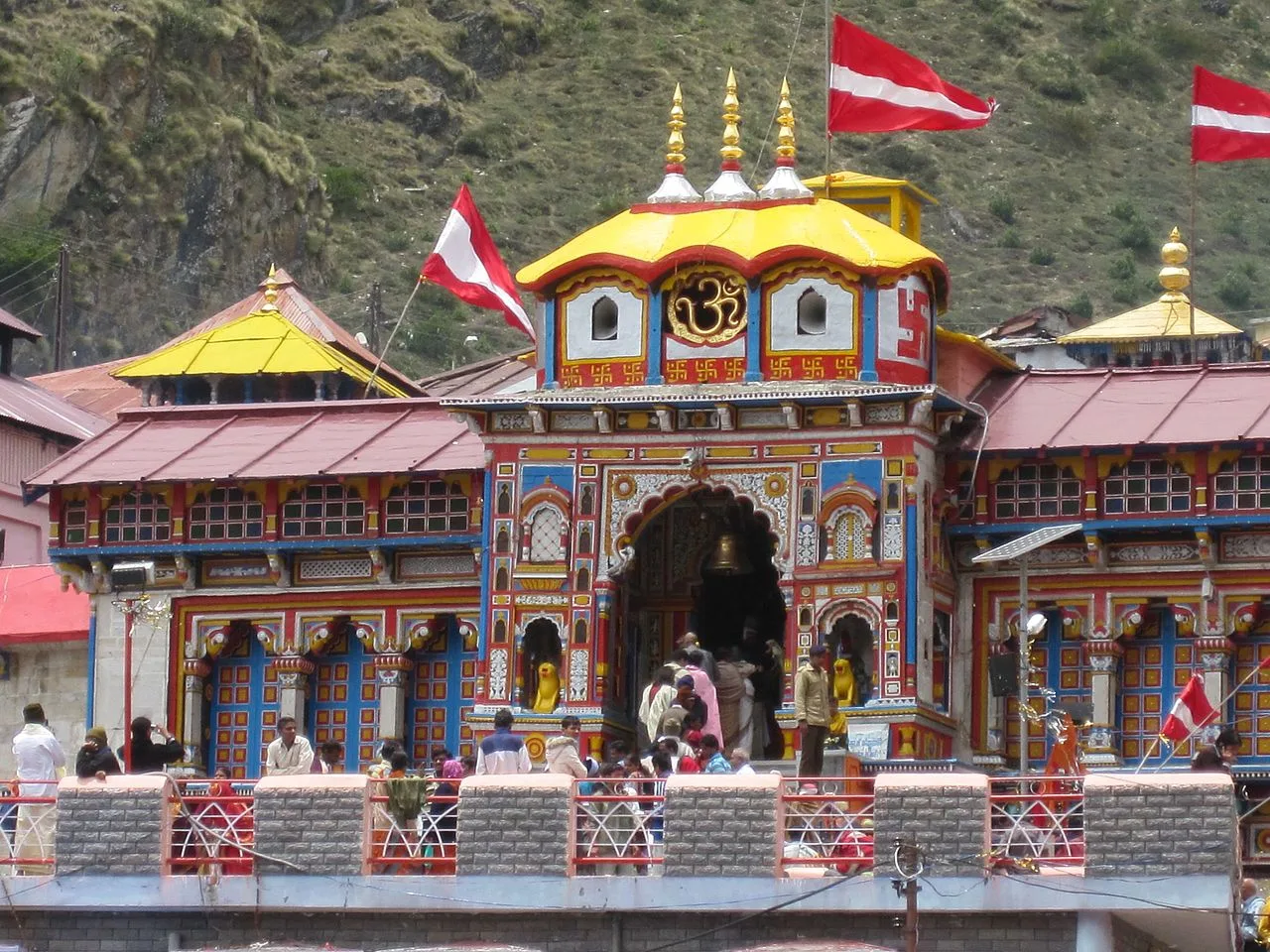
StyleNorth Indian Nagara style with Himalayan adaptations; facade resembles Buddhist vihara style — brightly painted with arched windows, Tibetan influence on roof
Height15 m (50 ft)
MaterialLarge stone slabs; gilt gold cupola on shikhara
Built By / EraCurrent structure: 16th century (Garhwal kings), rebuilt after 1803 earthquake by King of Jaipur
Highlights
- ·Singhdwar (Lion Gate): Colorful main arched entrance gate with carved decorations; temple facade painted in reds and yellows
- ·Tapt Kund (Hot Spring): Natural sulphur hot spring adjacent to the temple. Year-round temperature ~55°C (131°F) even when outside temperature stays below 17°C. Pilgrims traditionally bathe here before temple entry for ritual purification and believed healing properties.
- ·Narad Kund: Sacred cold-water kund (pond) near the temple; site where Adi Shankaracharya found the Shaligram idol of Badrinarayana.
- ·Brahma Kapal: A flat rocky platform on the right bank of the Alaknanda, ~100m from the temple. The most important shraddha (ancestral rites) site in Uttarakhand; Hindus believe pitru-tarpan (offering to ancestors) done here grants direct liberation to the deceased. More important than Gaya for pitru shraddha according to tradition.
Gallery

Badrinath Temple — front facade with colorful paintwork, July 2012
How to Reach
By Air317 km
Jolly Grant Airport, Dehradun (DED)Daily flights from Delhi (IndiGo, Air India, SpiceJet). From Dehradun, ~10–12 hr drive to Badrinath. Alternatively, helicopter service available for Char Dham circuit via IRCTC Heli Yatra (heliyatra.irctc.co.in). Distance from Rishikesh to Badrinath is ~297 km (Jolly Grant Airport is ~20 km south of Rishikesh on the Delhi highway).
By Train297 km
RishikeshNearest railhead with broad-gauge connectivity. Haridwar (~317 km from Badrinath, ~20 km further than Rishikesh) has better national train connectivity with more express trains from major cities. From either station, take shared/private taxis or GMVN/UPSRTC buses toward Badrinath via Devprayag–Rudraprayag–Chamoli–Joshimath.
By Trek / Heli16 km
IRCTC HeliYatra primarily for Kedarnath; Char Dham circuit helicopter packages available privately from Dehradun and Haridwar for all four dhams.
Tip: Best travel between May – June & Sep – OctWeather can change quickly in the Himalayas. Carry proper clothing.
Location Map
Shri Badrinath Temple (Badri Vishal), Uttarakhand Himalayas
Accommodation
Stay options near Badrinath
Book 2–3 months in advance for peak season (May–June, Sep–Oct). Most accommodation is only open during the temple season (April–November).
Nearby Places
Explore sacred places around Badrinath
🛕Tapt Kund
0.1 km🛕Mana Village
3.2 km🛕Vyas Gufa
3.5 km🛕Charanpaduka
3.0 km